DiffTetVR: Differentiable Tetrahedral Volume Rendering

Differentiable rendering is a technique that aims to invert the rendering process to enable optimizing rendering parameters from a set of images. In this article, we present a differentiable volume rendering solution called DiffTetVR for tetrahedral meshes. Unlike previous works based on regular grids, this enables the optimization of vertex positions and the local subdivision of the mesh without …

Lightweight Gradient-Aware Upscaling of 3D Gaussian Splatting Images

We introduce an image upscaling technique tailored for 3D Gaussian Splatting (3DGS) on lightweight GPUs. Compared to 3DGS, it achieves significantly higher rendering speeds and reduces artifacts commonly observed in 3DGS reconstructions. Our technique upscales low-resolution 3DGS renderings with a marginal increase in cost by directly leveraging the analytical image gradients of Gaussians for …

SGLDBench: A Benchmark Suite for Stress-Guided Lightweight 3D Designs

We introduce the Stress-Guided Lightweight Design Benchmark (SGLDBench), a comprehensive benchmark suite for applying and evaluating material layout strategies to generate stiff, lightweight designs in 3D domains. SGLDBench provides a seamlessly integrated simulation and analysis framework, including six reference strategies and a scalable multigrid elasticity solver to efficiently execute these …

Application of 3D Gaussian Splatting for Cinematic Anatomy on Consumer Class Devices

Interactive photorealistic rendering of 3D anatomy is used in medical education to explain the structure of the human body. It is currently restricted to frontal teaching scenarios, where even with a powerful GPU and high-speed access to a large storage device where the data set is hosted, interactive demonstrations can hardly be achieved. We present the use of novel view synthesis via compressed …

A Compact and Efficient Neural Data Structure for Mutual Information Estimation in Large Timeseries

Database systems face challenges when using mutual information (MI) for analyzing non-linear relationships between large timeseries, due to computational and memory requirements. Interactive workflows are especially hindered by long response times. To address these challenges, we present timeseries neural MI fields (TNMIFs), a compact data structure that has been trained to reconstruct MI …

Adaptive Sampling of 3D Spatial Correlations for Focus+Context Visualization

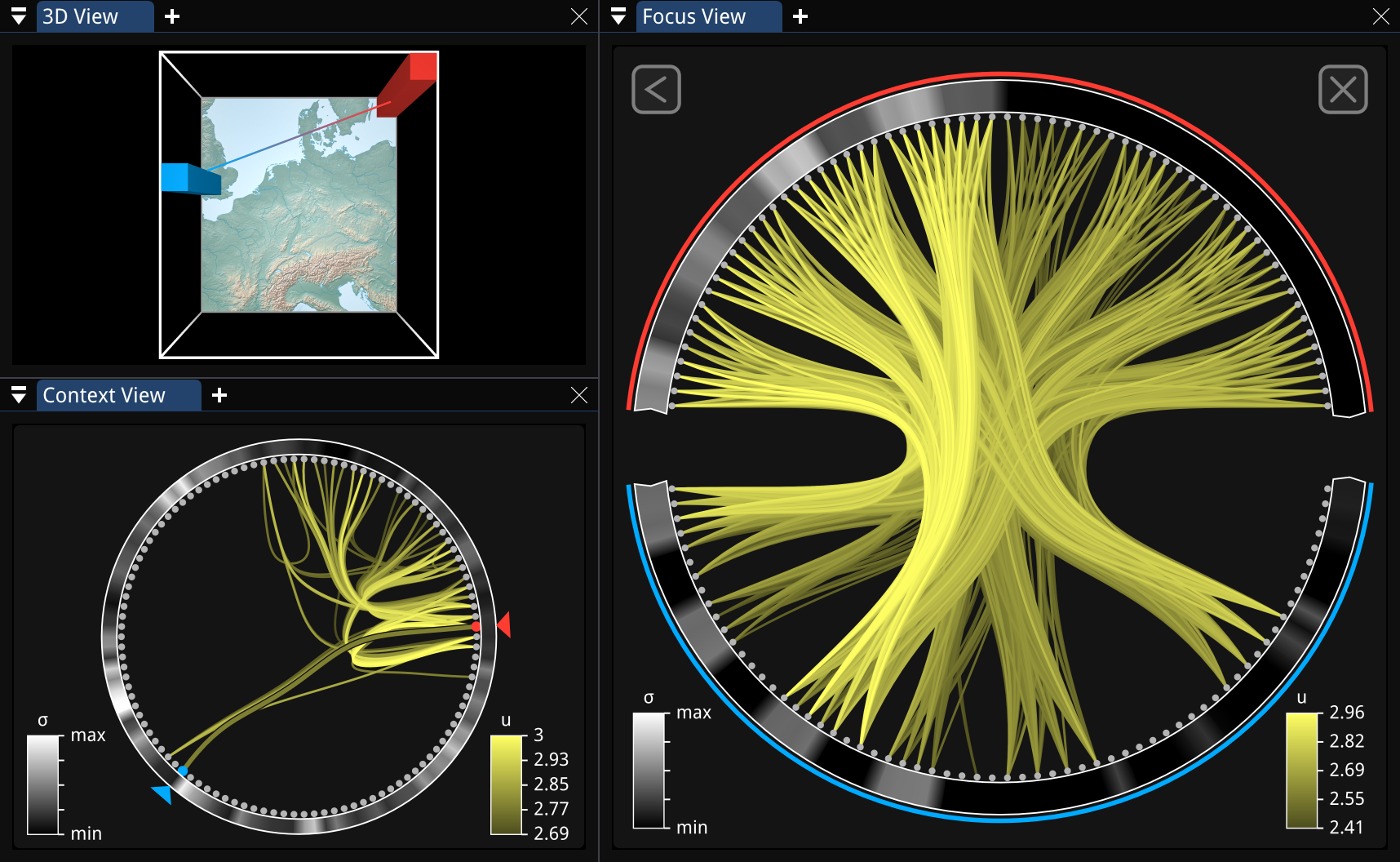
Visualizing spatial correlations in 3D ensembles is challenging due to the vast amounts of information that need to be conveyed. Memory and time constraints make it unfeasible to pre-compute and store the correlations between all pairs of domain points. We propose the embedding of adaptive correlation sampling into chord diagrams with hierarchical edge bundling to alleviate these constraints. …

Neural Fields for Interactive Visualization of Statistical Dependencies in 3D Simulation Ensembles

We present neural dependence fields (NDFs) - the first neural network that learns to compactly represent and efficiently reconstruct the statistical dependencies between the values of physical variables at different spatial locations in large 3D simulation ensembles. Going beyond linear dependencies, we consider mutual information as an exemplary measure of non-linear dependence. We demonstrate …

Visual analysis of model parameter sensitivities along warm conveyor belt trajectories using Met.3D (1.6.0-multivar1)

Numerical weather prediction models rely on parameterizations for subgrid-scale processes, e.g., for cloud microphysics, which are a well-known source of uncertainty in weather forecasts. Via algorithmic differentiation, which computes the sensitivities of prognostic variables to changes in model parameters, these uncertainties can be quantified. In this article, we present visual analytics …

Transfer Function Optimization for Comparative Volume Rendering

Direct volume rendering is often used to compare different 3D scalar fields. The choice of the transfer function which maps scalar values to color and opacity plays a critical role in this task. We present a technique for the automatic optimization of a transfer function so that rendered images of a second field match as good as possible images of a field that has been rendered with some other …

Efficient High-Quality Rendering of Ribbons and Twisted Lines

Flat twisting ribbons are often used for visualizing twists along lines in 3D space. Flat ribbons can disappear when looking at them under oblique angles, and they introduce flickering due to aliasing during animations. We demonstrate that this limitation can be overcome by procedurally rendering generalized cylinders with elliptic profiles. By adjusting the length of the cylinder's semi-minor …